
Contents
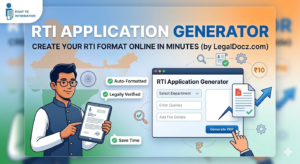 A lot of people hesitate to file a Right to Information (RTI) request because they aren’t sure what to write. The most common hurdle is the “format.” Whether you are checking a passport status or inquiring about local road repairs, the RTI Act 2005 is your most powerful tool for transparency.
The good news? You don’t need a lawyer. Our RTI Application Generator and this step-by-step guide will help you draft a professional request in minutes.
What is an RTI Application?
An RTI application is a formal request asking a government department (Public Authority) to provide specific information. Under the Act, every public office in India has a designated Public Information Officer (PIO) responsible for processing these requests.
What information can you request?
The information must already exist in government records. You can ask for:
- Official Documents: Copies of contracts, reports, or memos.
- Application Status: Real-time updates on passports, PAN cards, or licenses.
- File Notings: The internal remarks made by officers on your file.
- Inspection: The right to inspect government works or documents.
Note: You cannot ask for “opinions” or “reasons” why a policy was made; you can only ask for the records of that policy.
Do You Need a Specific RTI Application Format?
Strictly speaking, no. The RTI Act does not mandate a rigid form. You can write your request on a blank sheet of paper. However, for your application to be accepted without delays, it should follow this standard structure:
-
The Addressee: The Public Information Officer (PIO) and the Department name.
-
Subject Line: Clearly stating it is a request under the RTI Act, 2005.
-
The Queries: A numbered list of specific questions.
-
Identity Proof: A statement of your Indian citizenship.
-
Fee Details: Mention of the ₹10 payment (IPO/DD/Online).
Example of a Simple RTI Application Format
Below is a sample RTI template you can copy and use for most departments:
To,
The Public Information Officer (PIO)
[department]
[authority_name]
[authority_address]From,
[your_name]
[your_address]Date: [date_today_dd_mm_yyyy]
Subject: Application seeking information under the Right to Information Act, 2005
Respected Sir/Madam,
I, [your_name], a citizen of India, hereby submit this application under Section 6(1) of the Right to Information Act, 2005, seeking the following information:
**INFORMATION SOUGHT:**
[questions]
Time period for which information is sought: [time_period]
Format in which information is required: [format_requested]
[fee_statement]
**DECLARATION:**
I hereby declare that I am a citizen of India and the information sought does not fall within the restrictions set out in Section 8 and Section 9 of the RTI Act, 2005.I request you to kindly provide the above information within the statutory period of 30 days as prescribed under Section 7(1) of the RTI Act, 2005. In case you are not the concerned PIO, I request you to transfer this application to the concerned PIO under Section 6(3) of the RTI Act, 2005, within 5 days.
In case the information sought is denied or not provided within the stipulated period, I reserve my right to file a First Appeal under Section 19(1) of the RTI Act, 2005, before the First Appellate Authority.
Thanking you,
Yours faithfully,([your_name])
[your_address]
Use our Online RTI Application Generator
If you are worried about the wording or finding the right PIO address, using an RTI Application Generator is the most efficient method.
RTI Fees and Response Timeframes
To ensure your application isn’t rejected, you must follow the payment guidelines.
RTI Application Fee
-
Standard Fee: ₹10 (may vary slightly in some states for State Government departments).
-
Payment Modes: Indian Postal Order (IPO), Demand Draft, or Online via the RTI Online Portal.
-
Exemption: Applicants in the Below Poverty Line (BPL) category pay ₹0 (must attach proof).
How long does it take to get a reply?
-
Standard Request: 30 Days.
-
Transferred Request: 35 Days (if sent to the wrong department).
-
Life or Liberty: 48 Hours (if the info concerns a person’s immediate freedom/safety).
What to Do If Your RTI is Rejected or Ignored?
If you don’t receive a response within 30 days, the law provides a two-tier appeal process:
-
First Appeal: Filed with the First Appellate Authority (FAA) within the same department.
-
Second Appeal: Filed with the Information Commission (State or Central) if the First Appeal fails.
FAQs about Filing RTI in India
1. Can I file an RTI application online?
Yes. For Central Government departments, you can use the official portal (rtionline.gov.in). For State Government departments, rules vary by state. Our RTI Application Generator is the perfect solution for creating a physical application to mail when online options are unavailable.
2. What is the word limit for RTI questions?
For Central Government RTIs, there is generally a 500-word limit for the description of the information requested. It is best to keep your questions specific and concise to avoid technical rejections.
3. Do I need to provide a reason for my RTI?
No. According to Section 6(2) of the RTI Act, an applicant is not required to give any reason or personal details, except those necessary for contacting them (like your address).
4. Can a PIO reject my RTI request?
A Public Information Officer can only reject a request under Sections 8 or 9 of the RTI Act. These sections cover information that could affect national security, intellectual property, or cabinet papers. If rejected, the PIO must provide the specific reason and the contact details of the Appellate Authority.
5. Is there a fee for the first appeal?
No. At the Central Government level, there is no fee for filing a First Appeal. However, some states (like Maharashtra or Madhya Pradesh) may charge a small fee for state-level appeals.
6. Can I ask for information in my local language?
Yes. The RTI Act allows applications to be submitted in English, Hindi, or the official language of the area where the application is being made.
7. What happens if the PIO provides false information?
If a PIO knowingly gives incorrect, incomplete, or misleading information, they can be penalized by the Information Commission. The penalty is ₹250 per day, up to a maximum of ₹25,000, which is deducted from their salary.
8. How do I send an RTI application by post?
It is highly recommended to send your RTI via Registered Post or Speed Post with an “Acknowledgment Due” card. This provides you with legal proof of delivery, which is essential if you need to file an appeal later.
9. Can I file an RTI on behalf of someone else?
Technically, the right belongs to the “citizen.” While you can help someone draft it, the application should ideally be signed and filed by the individual seeking the information to avoid any “third-party” complications.