
Contents
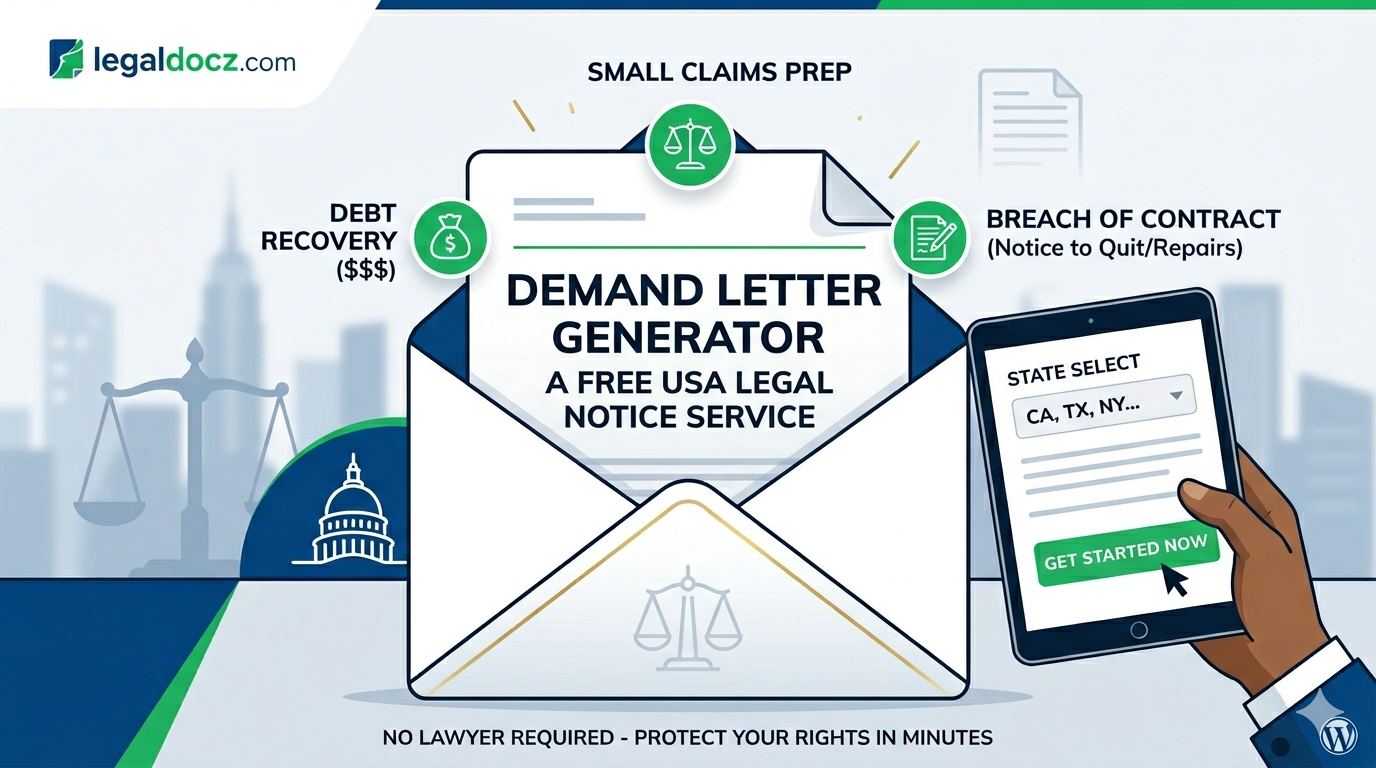 In the United States, the legal system is often seen as a place of high costs and endless paperwork. However, most civil disputes—from unpaid invoices to broken contracts—never actually need to reach a courtroom. The secret weapon for individuals and small businesses is the Demand Letter.
A well-crafted demand letter acts as a formal “line in the sand.” It transitions a dispute from a series of ignored emails and phone calls into a professional legal matter. In this guide, we explore the essential role of demand letters and how our Demand Letter Generator can help you protect your rights.
What Exactly is a Demand Letter?
A demand letter (also known as a Letter of Demand or Notice Before Action) is a formal document that outlines a grievance, demands a specific remedy (usually money or action), and sets a firm deadline for a response.
While it is not a lawsuit itself, it is the standard “pre-litigation” step. In states like California, Texas, and Florida, judges often look for proof that you sent a demand letter before they will allow your case to proceed in Small Claims Court.
The Three Goals of a Demand Letter:
-
Resolution: To get the recipient to pay or perform without a lawsuit.
-
Evidence: To prove to a judge that you acted reasonably and tried to settle the matter.
-
Clarity: To force the other party to state their defense in writing, which helps you prepare if you do go to court.
Small Claim Demand Letter Format
{sender_header_block}
{letter_date_formatted}
{debtor_address_block}
Re: Demand for payment
{debtor_salutation}
Please be advised that {debtor_name_for_body} owes me the sum of {amount_formatted} because {demand_reason}
This will be your only chance to settle this matter before I file suit against you in Small Claims Court. We can discuss a lump sum payment, or a payment plan. Please contact me on or before {response_deadline_formatted} for purposes of settling this matter. If I do not hear from you on or before {response_deadline_formatted}, I will file a lawsuit against you without further notice. It is in your best interest to settle this matter before a lawsuit is filed. If a judgment is obtained, you may be ordered to pay the debt plus interest (where applicable) and court fees. Additionally, your ability to obtain credit may be affected.
Based on the foregoing, I expect payment in the amount of {amount_formatted} made payable to me, {sender_full_name}, no later than {response_deadline_formatted}. (I can be reached at the phone number or address above.) If you decide to ignore this demand for payment, I will pursue all legal remedies available to me without further notice. This letter serves as evidence that I have attempted to resolve this matter informally.
Sincerely,
{signature_block}
🛠️ Generate Demand Letter in 2 Mins
When Should You Use a Demand Letter?
Demand letters are used across a wide variety of scenarios. If someone owes you an obligation and is failing to meet it, a demand letter is your first step.
-
Unpaid Business Invoices: If a client hasn’t paid for services rendered or goods delivered.
-
Breach of Contract: When a party fails to follow the terms of a signed agreement (e.g., a contractor who took a deposit but didn’t show up).
-
Personal Loans: When a friend or acquaintance refuses to pay back money lent in good faith.
-
Property Damage: After a car accident or a neighbor damaging your fence.
-
Insurance Claims: Demanding a settlement from an insurance provider who is “low-balling” your claim.
-
Return of Property: When someone is holding your equipment, tools, or personal items illegally.
The Anatomy of a High-Impact Demand Letter
For a demand letter to be effective, it must follow a specific professional structure. If it is too aggressive, it might be ignored; if it is too soft, it won’t be taken seriously.
A. The Professional Header
Include your full legal name and address, the date, and the recipient’s full details. In the US, accuracy here is critical for “Proof of Service.”
B. The Facts (Chronological Order)
Describe what happened without using emotional language.
-
Bad: “You lied to me and stole my money.”
-
Good: “On January 15, 2026, we entered into an agreement for [Service]. I paid a deposit of $500, but as of March 21, the work remains incomplete.”
C. The Demand & Calculation
Be extremely specific. If you are asking for money, break down the costs (Principal + Late Fees + Interest, if applicable).
D. The Deadline
A “reasonable” deadline in the US is typically 10 to 14 business days. This gives the recipient enough time to consult a professional but maintains a sense of urgency.
E. The “Next Steps” Warning
State clearly that if the demand isn’t met, you will pursue further legal action, such as filing in Small Claims Court or reporting the debt to a credit bureau.
Sending Your Letter: The “Certified Mail” Rule
In the US, an email is rarely considered a “formal” legal notice in the eyes of many local courts. To ensure your letter carries weight:
-
Print and Sign: Hand-sign the document.
-
Certified Mail, Return Receipt Requested: This is the industry standard. It provides you with a “Green Card” signed by the recipient, which is your evidence in court that they received the demand.
-
Keep a Copy: Always keep a digital and physical copy of the signed letter and the mailing receipt.
Frequently Asked Questions (FAQs)
1. Is a demand letter legally required before suing? In many US states, yes—especially for Small Claims Court. Even where not strictly required, judges often penalize plaintiffs who didn’t try to settle the matter out of court first.
2. Can I write a demand letter myself? Yes. You do not need a lawyer to send a demand letter. Our generator is designed to help you create a professional-grade document that follows standard legal formatting.
3. What if the recipient ignores my demand letter? If the deadline passes without a response, you have established a “good faith” attempt to settle. Your next step is usually filing a claim in Small Claims Court or hiring a collection agency.
4. Can I demand interest on the money owed? Only if it was specified in a signed contract or if your state law allows for “pre-judgment interest.” Be careful not to exceed “Usury Laws” (maximum interest limits).
5. How much can I sue for in Small Claims Court? This varies wildly by state—from $2,500 in Kentucky to $25,000 in Delaware. Always check your local county limits before sending your demand.
6. Does a demand letter need to be notarized? Generally, no. A signature is sufficient. The “proof” comes from the Certified Mail receipt, not a notary seal.
7. Can I send a demand letter via email? You can, but it is less effective. We recommend sending both: an email for speed and Certified Mail for legal “Proof of Service.”
8. What tone should I use in the letter? Professional, calm, and factual. Avoid threats or insults. Remember, a judge might read this letter later—you want to look like the “reasonable” party.
9. Can a demand letter backfire? If you make false claims or threaten something illegal (like physical harm), it can hurt your case. Stick strictly to the facts of the dispute.
10. How long does it take for a demand letter to work? Many disputes are settled within 48 hours of the recipient receiving the Certified Mail. The “formality” of the letter often scares debtors into paying.
Conclusion: Take Control of Your Legal Rights
Don’t let a dispute linger and cause you stress. Whether you’re a freelancer chasing a payment or a homeowner dealing with a bad contractor, a professional demand letter is your best first step toward a resolution.
Use the LegalDocz Demand Letter Generator today and send a clear message: you are serious about your rights, and you are ready to take action.