
Contents
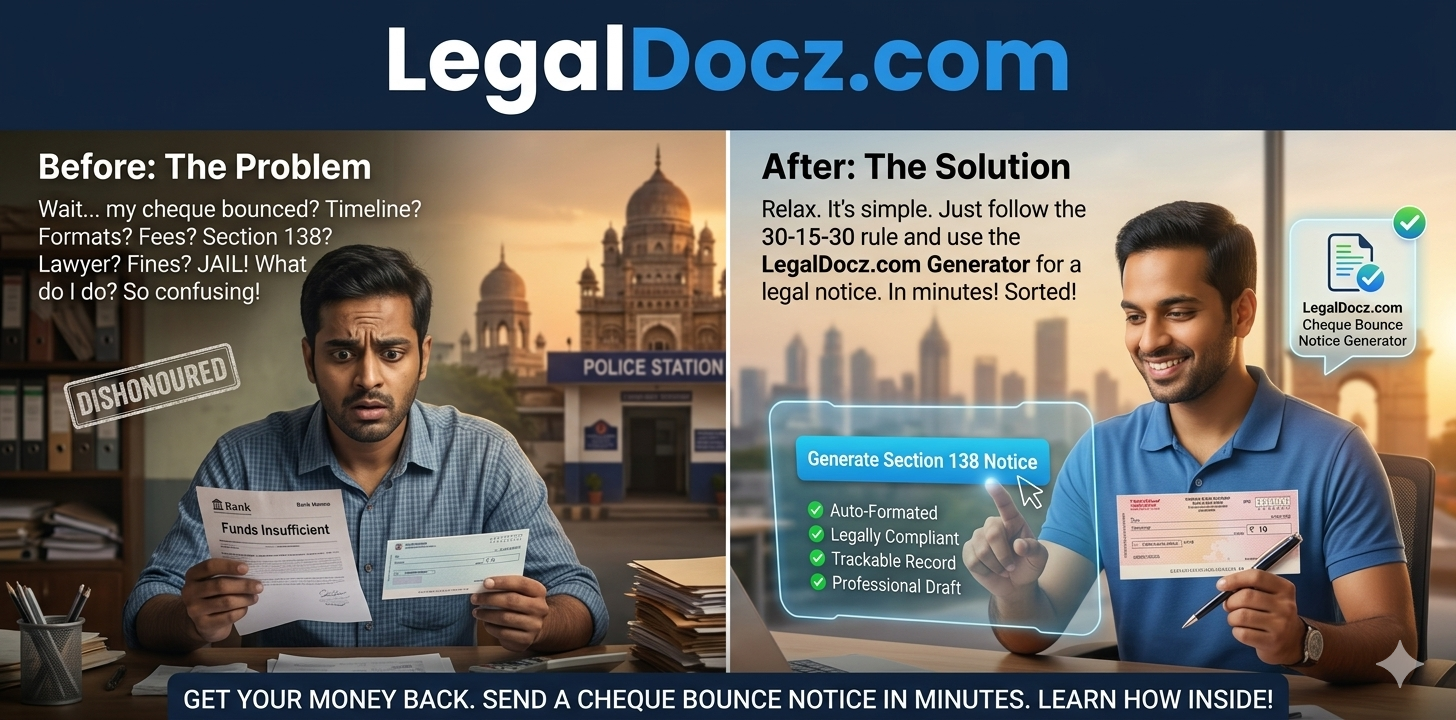 Even in the age of instant UPI transfers and digital banking, cheques remain the backbone of Indian business transactions, property deals, and private loans. However, when a cheque “bounces”—officially termed as dishonour of cheque—it is more than just a financial hiccup. In India, it is a criminal offense.
Under Section 138 of the Negotiable Instruments Act, 1881, a person who issues a bounced cheque can face up to two years of imprisonment, a fine of up to twice the cheque amount, or both. But there is a massive catch: the law is incredibly strict about timelines. If you miss a single deadline, your right to file a criminal case vanishes.
Why Do Cheques Bounce?
While “Insufficient Funds” is the most common reason, the law covers several scenarios under the same criminal umbrella:
-
Funds Insufficient: The most common reason.
-
Account Closed: The drawer closed the account before you could encash the payment.
-
Stop Payment: The drawer intentionally instructed the bank not to clear the cheque.
-
Signature Mismatch: Often used as a deliberate delay tactic.
-
Refer to Drawer: A general instruction from the bank to contact the account holder.
Sample Cheque Bounce Notice Format
THROUGH REGISTERED POST A.D.
LEGAL NOTICE
(Under Section 138 of the Negotiable Instruments Act, 1881)Date: {date_today_dd_mm_yyyy}
{through_line}
FROM:
{sender_name}
{sender_address}
{through_advocate_line}TO:
{recipient_name}
{recipient_address}SUBJECT: Legal Notice under Section 138 of Negotiable Instruments Act, 1881 for dishonour of Cheque No. {cheque_number} for Rs. {cheque_amount}/-
Dear Sir/Madam,
{opening_paragraph}
**FACTS OF THE CASE:**
1. That you had issued a cheque bearing No. {cheque_number} dated {date_on_cheque} for an amount of Rs. {cheque_amount}/- drawn on {drawee_bank_name_branch} in favour of the noticee/my client towards discharge of your legally enforceable debt/liability.
2. That the said cheque was presented for encashment on {date_of_presentation} but the same was dishonoured/returned unpaid by the bank on {date_of_dishonour} with the endorsement “{reason_for_dishonour}”.
3. That the dishonour of the said cheque clearly establishes your intention to defraud and deceive my client, which constitutes an offence punishable under Section 138 of the Negotiable Instruments Act, 1881.
**LEGAL BASIS:**
The dishonour of the cheque constitutes an offence under Section 138 of the Negotiable Instruments Act, 1881, which is punishable with imprisonment for a term which may extend to two years, or with fine which may extend to twice the amount of the cheque, or with both.
As per Section 138, the notice is required to be sent within 30 days of receipt of information of the dishonour from the bank (proviso (b) to Section 138). The payee is entitled to file a complaint within 15 days of the expiry of the notice period if the amount is not paid (proviso (c) to Section 138).
**DEMAND:**
You are hereby called upon and required to, within {compliance_period} from the date of receipt of this notice:
1. Pay the cheque amount of Rs. {cheque_amount}/- along with interest and incidental charges;
2. {relief_demand_sought}
{consequence_warning}
{additional_information}This notice is being sent to you without prejudice to the rights and remedies available to my client under the law, all of which are expressly reserved.
Please treat this notice as a final opportunity to resolve the matter amicably, failing which my client shall be constrained to initiate appropriate legal proceedings against you, at your risk and cost.
Yours faithfully,
{signature_block}
🛠️ Need a Ready-to-Send Cheque Bounce Legal Notice?
Drafting a legal notice manually is risky. One wrong date or a missing legal clause can lead to your case being dismissed by the Magistrate. We have built the LegalDocz Cheque Bounce Notice Generator to solve this. Simply enter the cheque details, and our tool generates a legally compliant PDF formatted as per 2026 judicial standards.
Read the guide below to understand the legal process.
The “30-15-30” Rule: The Most Important Timeline in Indian Law
If you want to recover your money through the court system, you must follow the “30-15-30” rule. Indian courts are extremely strict regarding these limitations; even a one-day delay can ruin your case.
1. The 30-Day Window (Sending the Notice)
The moment your bank returns the cheque with a “Cheque Return Memo,” your clock starts. You must send a formal, written demand notice to the drawer within 30 days of receiving that memo. If you send it on the 31st day, the criminal liability under Section 138 is gone.
2. The 15-Day Grace Period (Waiting for Payment)
Once the drawer receives your notice, the law gives them a 15-day “cure period” to pay the amount. You cannot file a police complaint or a court case during these 15 days. If they pay within this window, the matter is legally settled.
3. The 30-Day Filing Window (Going to Court)
If the 15-day grace period expires and you still haven’t received your money, you have exactly 30 days to file a criminal complaint before the Judicial Magistrate. If you miss this, you lose the right to prosecute them criminally.
Essential Elements of a Valid Section 138 Notice
For a notice to be legally valid in any Indian court, it must contain these specific elements:
-
Nature of Debt: You must state that the cheque was issued to discharge a “legally enforceable debt” (e.g., payment for services, goods, or a loan). You cannot file a 138 case for a “gift” or “donation.”
-
Cheque Particulars: Clearly mention the Cheque Number, Date, Amount, and the Bank Name.
-
The Return Memo details: Mention the date the cheque was presented and the exact reason for dishonour stated by the bank.
-
The 15-Day Demand: A clear statement giving the drawer 15 days from the receipt of the notice to pay the principal amount.
-
The Legal Warning: A formal notice that failure to pay will result in criminal prosecution under the Negotiable Instruments Act.
Step-by-Step Guide: How to Send the Notice
Step 1: Secure Your Evidence Keep the original cheque and the original Return Memo from the bank in a safe place. These are your primary pieces of evidence.
Step 2: Generate the Notice Use the LegalDocz Generator to ensure your draft includes the latest Supreme Court precedents regarding jurisdiction.
Step 3: Dispatch via Registered Post/Speed Post Do not send the notice via WhatsApp or simple email alone. To prove “service of notice” in court, you must send it via Registered Post with Acknowledgment Due (RPAD) or Speed Post. Keep the postal receipt and the online tracking report as gold-standard proof.
Step 4: Track the Delivery The 15-day grace period starts from the date the drawer receives the notice. Check the tracking status online to know when that period begins.
Frequently Asked Questions (FAQs)
1. Can I file a Section 138 case for a “Security Cheque”? Yes. As long as the debt has become “due” and the cheque was intended to be encashed upon a default in payment, it is a valid case.
2. What if the drawer refuses to accept the notice? If a notice is sent to the correct address and the drawer “refuses” it, the law treats this as “Constructive Service.” It is legally considered delivered.
3. Is a cheque bounce offense bailable? Yes, it is a bailable offense. The accused will typically be granted bail upon their first appearance in court after the summons is issued.
4. Can I file a case if the cheque was for a “Friendly Loan”? Yes, provided you have some proof of the loan (like an agreement or a bank transfer). However, if the loan was in cash and exceeded ₹20,000, it might face scrutiny under Income Tax laws.
5. How much is the court fee? The court fee varies by state but is generally a small percentage of the cheque amount (usually between 2% to 5%).
6. Do I need a lawyer to send the notice? While a lawyer is recommended for the court trial, the “Payee” can legally send the notice themselves. Using our LegalDocz Generator ensures the language is professional and legally accurate.
7. What is the validity of a cheque in 2026? A cheque is generally valid for 3 months from the date written on it. You must present it to the bank within this window.
8. Can a company be sued for a cheque bounce? Yes. Under Section 141, the company and every person in charge (Directors/Managers) at the time of the offense can be prosecuted.
9. Can the case be settled later? Yes. Cheque bounce cases are “compoundable.” This means the parties can settle the matter at any time during the trial if the accused pays the amount.
10. Where should I file the case? The case must be filed in the court within whose jurisdiction the branch of the bank where the payee (you) maintains an account is located. This was a major pro-citizen amendment to the Act.
Why Use LegalDocz.com?
In the world of law, “Technicalities” are what win or lose cases. Our Cheque Bounce Notice Generator eliminates human error. It combines deep legal logic with ease of use, giving you a notice that even a seasoned lawyer would approve of. Don’t let your hard-earned money go to waste—take legal action today.