
Contents
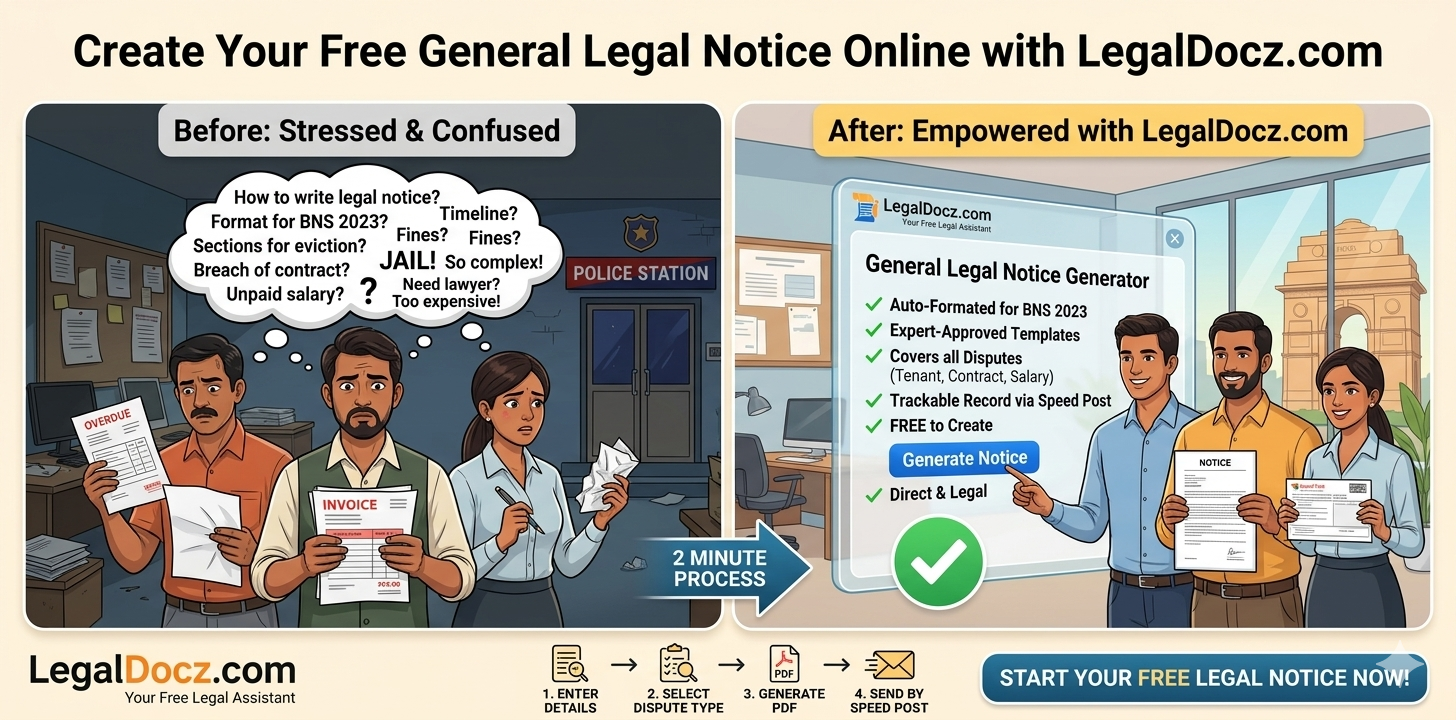 In legal matters, “verbal” holds very little weight. If you have a dispute—whether it’s with a landlord, a vendor, or a neighbor—your first official action must be to put it in writing. This is where a General Legal Notice comes in.
It is a formal communication sent by one party to another, explicitly stating a grievance, demanding a specific action, and giving a final opportunity to resolve the matter before escalating to court. A properly drafted general notice is crucial because it acts as vital evidence that you followed due process under India’s new laws.
When to Use a General Legal Notice
A “General Notice” is a versatile tool. You don’t always need a specific notice (like for a cheque bounce). You can use this general format for a wide range of common disputes:
-
Landlord-Tenant Disputes: Demanding unpaid rent, asking a tenant to vacate, or demanding the return of a security deposit.
-
Contractual Breaches: Warning a vendor who failed to deliver goods or services as per an agreement.
-
Employee-Employer Issues: A notice from an employee for unpaid salary or wrongful termination, or a notice from an employer regarding a breach of a non-compete clause.
-
Consumer Complaints: A final warning to a company for defective products or deficient service before filing a case in Consumer Court.
-
Property Disputes: Warning against encroachment or demanding the execution of a sale agreement.
-
Family/Matrimonial Matters: A notice for restitution of conjugal rights or demanding maintenance.
🛠️ Draft Your General Legal Notice in 2 Minutes – FOR FREE
Don’t get lost in complex legal formats or outdated templates. We’ve built the LegalDocz General Notice Generator to do the work for you. Simply select your dispute type, enter the facts, and our tool produces a professionally drafted, legally compliant PDF formatted as per the latest standards.
Understanding the Legal Framework: BNS 2023
While a general notice is often based on civil law (like the Indian Contract Act, 1872), it must always leave room for criminal consequences to ensure it is taken seriously. This means referencing the Bharatiya Nyaya Sanhita (BNS), 2023.
Depending on your unique situation, your notice may need to mention these key BNS sections:
1. Section 316 of BNS (Replaces Section 406 IPC) – Criminal Breach of Trust
If you entrusted someone with property or money (like a security deposit with a landlord or raw materials with a vendor) and they used it dishonestly or refuse to return it.
2. Section 318(4) of BNS (Replaces Section 420 IPC) – Cheating
If someone intentionally deceived you from the beginning to induce you to deliver property or money (like a fraudulent investment scheme).
3. Section 351(2) of BNS (Replaces Section 503/506 IPC) – Criminal Intimidation
If the dispute involves threats to your person, reputation, or property, this section applies.
4. Section 329 of BNS (Replaces Section 441/447 IPC) – Criminal Trespass
Highly relevant for property disputes, land encroachment, or illegal possession.
Key Elements of a 2026 General Notice Format
A vague notice is a useless notice. To be legally effective, your general notice must contain:
-
Clear Parties: The correct full names and addresses of both the Sender (you) and the Addressee (the other party).
-
A Detailed Statement of Facts: A chronological explanation of the events, agreements, or promises that led to the dispute. Be factual, not emotional.
-
The Specific Grievance: Clearly state why you are sending the notice (e.g., “Non-payment of salary for the month of April 2026”).
-
The Specific Demand (The ‘Cure’): Explicitly state what you want them to do (e.g., “Pay the outstanding amount of ₹50,000” or “Vacate the premises”).
-
The Timeline: Give a specific time limit (usually 15 days or 30 days) for them to comply.
-
The Consequences: A clear warning that failure to comply will lead to legal action (both civil and criminal) in a court of competent jurisdiction.
Step-by-Step: The Process of Sending a Notice
Step 1: Drafting Use the LegalDocz Generator to create your precise draft. Ensure you select the correct ‘type of dispute’ so the generator can apply the appropriate BNS logic.
Step 2: Signature and Review Print the draft on plain A4 paper (or green paper if required in your state), review it for accuracy, and sign it. You do not need a lawyer to send a general notice.
Step 3: Dispatch via Speed Post This is the most critical step. Do NOT send the notice via simple email or WhatsApp alone. Indian courts primarily recognize proof of delivery via Registered Post with Acknowledgment Due (RPAD) or Speed Post. The postal receipt and online tracking report are your vital evidence.
Step 4: Acknowledgment (The ‘AD Card’) If you sent it via RPAD, you will receive a signed Acknowledgment Due (AD) card back from the post office, proving that the addressee received the notice. Keep this and the original receipt very safe.
Frequently Asked Questions (FAQs)
1. Is a legal notice mandatory before filing a civil case? It is mandatory for certain specific cases (like against the government under Section 80 CPC or under the Insolvency and Bankruptcy Code). For general civil disputes, while not always mandatory, it is highly recommended to show “Good Faith” and save court time.
2. Can I send a legal notice myself or do I need a lawyer? Yes, you can absolutely send a legal notice yourself. While a lawyer is recommended for the trial, anyone can draft and send a final demand notice. Our LegalDocz Generator provides a professional, expert-approved format for free.
3. What happens if the other party ignores my notice? If the 15-day or 30-day period mentioned in your notice expires, you have the full right to proceed with filing a civil suit or a criminal complaint, using the proof of service of your notice as evidence of their non-compliance.
4. Can a legal notice be sent by email or WhatsApp? While courts are increasingly recognizing digital communication, a WhatsApp message or simple email is still considered a “secondary” form of service. To avoid technical rejections, you should always send a physical copy via Speed Post or RPAD in addition to any digital communication.
5. Do I need to get the notice notarized? No, a legal notice does not need to be notarized. The proof of dispatch (postal receipt) is what makes it legally valid.
6. What is the time limit for sending a legal notice? It depends on the specific dispute type (the limitation period is usually 3 years from the date the dispute arose). However, you should always send a notice as soon as the conflict becomes unresolvable through casual communication.
7. Can a legal notice be withdrawn? Yes. If both parties reach a settlement after the notice is sent, you can issue a formal “withdrawal of notice” to officially close the matter.
8. Can a legal notice be issued to a minor? No, a legal notice cannot be sent to a minor. It must be addressed to the minor’s natural guardian (parent or legal guardian).
9. What BNS section replaces IPC 420 for cheating in a notice? The new section for cheating in the Bharatiya Nyaya Sanhita (BNS) is Section 318(4).
10. How much does a legal notice cost? A lawyer may charge anywhere from ₹2,000 to ₹10,000. However, using the LegalDocz Generator allows you to create a professional notice for free, making legal access affordable for all.
Why Use LegalDocz.com?
We believe legal procedures shouldn’t be confusing or expensive. Our General Notice Generator combines expert legal logic with the ease of automation. By ensuring your notice is formatted correctly and references the relevant BNS 2023 sections, we help you take the first, professional step toward resolving your dispute—quickly and on your own terms.