
Contents
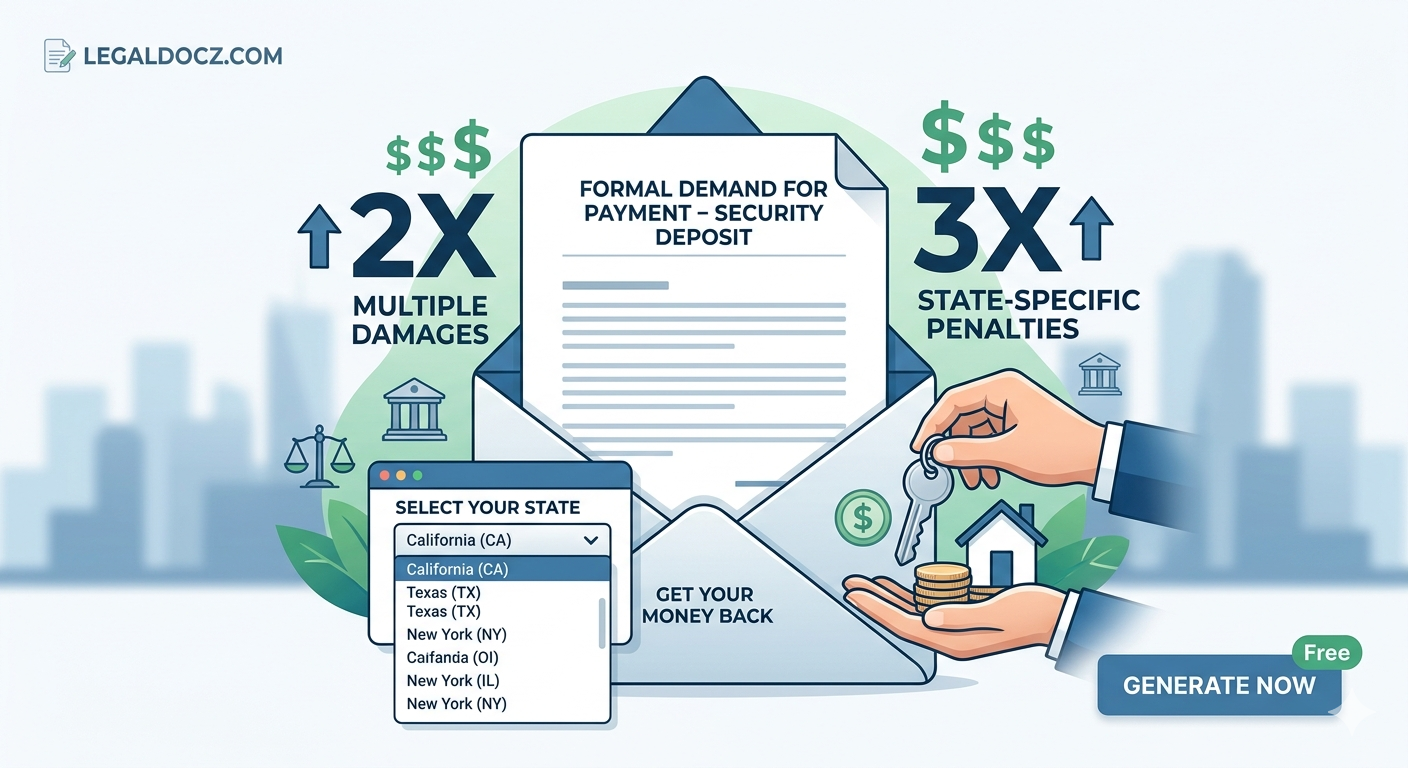 Moving out of a rental property marks the end of a chapter, but for many tenants, it marks the beginning of a frustrating battle: recovering the security deposit. In the United States, security deposit disputes are among the most common cases in Small Claims Court. However, most tenants don’t realize that a single, well-drafted document—the Security Deposit Demand Letter—can often resolve the issue without ever stepping into a courtroom.
In this guide, we break down the legal landscape for US renters and provide you with a state-specific generator to protect your financial rights.
What is a Security Deposit Demand Letter?
A security deposit demand letter is a formal, written request sent by a tenant to a former landlord. It asserts the tenant’s right to a refund and provides the landlord with a final opportunity to pay before legal action is taken.
In many states, such as California and Texas, sending this letter is not just a good idea—it is a legal prerequisite for filing a lawsuit. If you skip this step, a judge may dismiss your case or refuse to award you the “penalty damages” you might otherwise be entitled to.
Security Deposit Demand Letter Format
(sender_header_block}
(letter_date_formatted}
(landlord_address_block}
Re: Return of security deposit — (rental_unit_one_line}
Dear (landlord_name}:
I am writing to demand the return of my security deposit for the rental property at:
(rental_property_address_block}
I moved in on (move_in_formatted} and vacated on (move_out_formatted}. The security deposit I paid was (deposit_amount_formatted}.(deposit_transaction_details_block}
Under (property_state_law_citation}, you are required to return my security deposit, less only lawful deductions for unpaid rent or damage beyond ordinary wear and tear, within the time period and in the manner required by law.
Please mail the full deposit (or a written, itemized statement of any lawful deductions with any remaining balance) to me at the address shown above within the time required by law. If you fail to comply, I will pursue all remedies available to me, including small claims court where appropriate.
Sincerely,
(signature_block}
 Generate Security Deposit Demand Letter in 2 Mins
Why this is the Year of Tenant Rights
Several states have updated their “Bad Faith” statutes. Courts are becoming less tolerant of landlords who use security deposits as a “slush fund” for property upgrades.
Key Legal Protections You Should Know:
-
The 14-Day Rule: States like New York now strictly enforce a 14-day window. If your landlord misses this, they often forfeit the right to keep any money, even if there was legitimate damage.
-
Penalty Multipliers: In Massachusetts and Colorado, “willful” withholding can result in Treble Damages (3x the original deposit).
-
Interest Accrual: In states like Connecticut and Maryland, landlords are required to keep your deposit in an interest-bearing account and return that interest to you.
Normal Wear and Tear vs. Damage: The Gray Area
The most common excuse landlords use to keep money is “cleaning and repairs.” However, US law makes a sharp distinction between Normal Wear and Tear (which the landlord pays for) and Damage (which you pay for).
| Feature | Normal Wear and Tear (Landlord Pays) | Damage (Tenant Pays) |
| Walls | Faded paint, minor scuffs, small nail holes. | Large holes, unapproved paint colors, drawings. |
| Floors | Carpet thinning in high-traffic areas. | Cigarette burns, pet urine stains, deep gouges. |
| Cleaning | Dust on blinds, “broom clean” floors. | Trash left behind, mold from neglect, filth. |
| Fixtures | Faucets leaking due to old age. | Broken mirrors, missing light shades. |
Step-by-Step: How to Use This Letter Effectively
Generating the letter is only half the battle. You must execute the delivery correctly to ensure it stands up in court.
Step 1: Verify the Deadline
Check your state’s deadline (usually 14, 21, or 30 days). Do not send the demand letter before this deadline has passed unless the landlord has already sent you an unfair itemized list of deductions.
Step 2: Include Evidence
If you have photos of the apartment on the day you moved out, mention them in the letter. Our generator includes a section where you can reference your “Move-out Inspection Report.”
Step 3: Send via Certified Mail
This is the most important step. In the US legal system, “I didn’t get the letter” is a common defense. Sending it via USPS Certified Mail, Return Receipt Requested gives you a green postcard signed by the landlord. This is your “smoking gun” evidence for a judge.
Frequently Asked Questions (FAQs)
1. Can my landlord charge me for professional carpet cleaning?
In most states, no—unless there are unusual stains. Routine carpet cleaning between tenants is considered a cost of doing business for the landlord.
2. What if my landlord sold the building?
The “successor landlord” is legally responsible for your deposit. Your demand letter should be sent to the current owner/management company.
3. Does the 21-day clock start when I give notice or when I move out?
The clock almost always starts the day you “surrender the premises” (return the keys) and provide a written forwarding address.
4. Can I sue for more than my deposit?
Yes. If you can prove “bad faith,” you can sue for statutory penalties (2x or 3x the amount) plus court filing fees and, in some cases, attorney fees.
5. How much does it cost to file a Small Claims case?
Depending on your county, filing fees range from $30 to $150. You can usually add this cost to your total demand.
6. What if I broke my lease early?
Your landlord may be able to deduct unpaid rent or “re-renting costs,” but they still must provide an itemized statement within the state’s deadline.
7. Is an email a “legal” demand letter?
While better than nothing, many US judges still prefer a physical letter sent via mail. Use our generator to create a PDF and mail it to be safe.
8. My landlord says they don’t have to return the deposit until a new tenant moves in. Is that true?
No. State laws set fixed deadlines (e.g., 30 days) regardless of whether the unit is occupied or vacant.
9. What is an “itemized statement”?
It is a detailed list of every deduction, often including copies of receipts or invoices. A note saying “Cleaning – $500” is usually legally insufficient.
10. How long do I have to sue my landlord?
The “Statute of Limitations” varies, but in most states, you have 2 to 4 years to sue for a security deposit. However, it is best to act within the first 6 months.
Landlords count on tenants being too busy or too intimidated to fight back. A professional demand letter changes the dynamic immediately—it moves you from a “complaining tenant” to a “prepared litigant.” Use the LegalDocz Security Deposit Demand Letter Generator today and take the first step toward getting back what is rightfully yours.