
Contents
In California, your security deposit is legally considered your money held in trust by the landlord. California law has become even more protective of tenants, introducing strict limits on deposit amounts and mandatory photographic evidence for deductions.
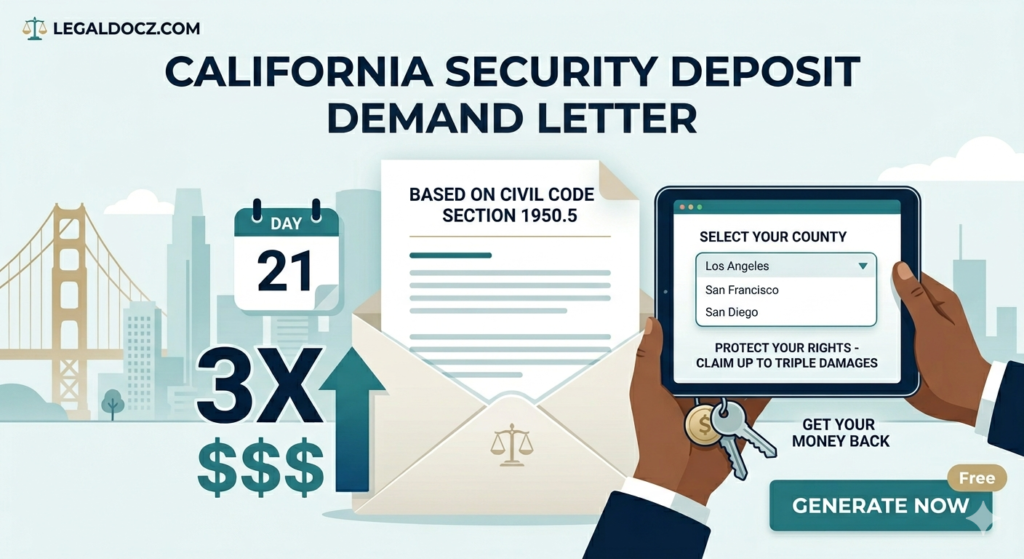
If you are struggling to get your refund, understanding California Civil Code Section 1950.5 is your best defense. Below is everything you need to know about the “21-Day Rule” and how to use our generator to demand your money back.
Security Deposit Demand Letter Format
(sender_header_block}
(letter_date_formatted}
(landlord_address_block}
Re: Return of security deposit — (rental_unit_one_line}
Dear (landlord_name}:
I am writing to demand the return of my security deposit for the rental property at:
(rental_property_address_block}
I moved in on (move_in_formatted} and vacated on (move_out_formatted}. The security deposit I paid was (deposit_amount_formatted}.(deposit_transaction_details_block}
Under CA Civil Code § 1950.5(g), you are required to return my security deposit, less only lawful deductions for unpaid rent or damage beyond ordinary wear and tear, within the time period and in the manner required by law.
Please mail the full deposit (or a written, itemized statement of any lawful deductions with any remaining balance) to me at the address shown above within the time required by law. If you fail to comply, I will pursue all remedies available to me, including small claims court where appropriate.
Sincerely,
(signature_block}
🛠️ Generate California Security Deposit Demand Letter Generator in 2 Mins
The California “21-Day Rule”
Under CA Civil Code § 1950.5(g), your landlord has exactly 21 calendar days after you vacate the premises to do one of two things:
-
Send you a full refund of your security deposit.
-
Send you an itemized statement listing each deduction, along with the remaining balance and copies of receipts.
The Penalty for Missing the Deadline: If the landlord fails to provide the statement or refund within 21 days, they may forfeit their right to keep any portion of the deposit, regardless of whether there was actual damage to the unit.
The Photo Documentation Rule
Following recent legislative updates (AB 2801), California landlords are now required to provide photographic evidence of any damages they are deducting for.
-
Move-In Photos: For leases starting after July 2025, landlords must have “before” photos.
-
Move-Out Photos: Landlords must take “after” photos before any repairs or cleaning begin and include them with your itemized statement.
-
The “Reasonably Necessary” Standard: Deductions must be reasonably necessary. Automatic “cleaning fees” or “carpet cleaning fees” written into a lease are generally illegal in California unless the unit is actually dirty beyond normal use.
Normal Wear and Tear vs. Damage
California law is very clear: you cannot be charged for “Ordinary Wear and Tear.” This refers to the natural deterioration that occurs from everyday living.
| Normal Wear and Tear (Landlord Pays) | Tenant Damage (You Pay) |
| Faded paint or minor scuffs | Large holes in the wall or unapproved paint |
| Carpet worn thin from walking | Stains, burns, or pet urine in the carpet |
| Loose doorknobs or leaky faucets | Broken windows or mirrors |
| Dust on blinds or baseboards | Missing fixtures or broken appliances |
Security Deposit Limits (AB 12 Update)
As of late 2024 and through 202X, the maximum security deposit a California landlord can charge is one month’s rent, regardless of whether the unit is furnished or unfurnished.
-
Exception: Small landlords (owning no more than two properties with a total of four units) may still charge up to two months’ rent.
California Security Deposit FAQs
1. What if my landlord ignores my 21-day demand?
If the 21 days pass, send a formal demand letter (use our generator). If they still don’t pay, your next step is Small Claims Court, where individuals can sue for up to $12,500.
2. Can I get “Triple Damages” in California?
Yes. Under Civil Code 1950.5(l), if a judge decides the landlord withheld your money in “bad faith,” they can award you the original deposit plus twice the amount as a penalty (Total = 3x).
3. Does the landlord have to give me a “Pre-Move Out Inspection”?
Yes. You have the right to request an initial inspection within the last two weeks of your tenancy. The landlord must give you an itemized list of needed repairs so you have a chance to fix them yourself.
4. Can my landlord deduct for “Professional Cleaning”?
Only if it is necessary to return the unit to the same level of cleanliness it was in when you moved in. They cannot charge for “routine” cleaning if you left it “broom clean.”
5. What if the repairs cost less than $125?
If total deductions are less than $125, the landlord does not have to provide receipts unless you specifically request them in writing.
6. Is a “Non-Refundable” deposit legal in California?
No. Under CA law, no security deposit is non-refundable. Any fee labeled “security,” “cleaning,” or “pet deposit” must be treated as refundable.
7. Can my landlord use my deposit for the last month’s rent?
Generally, no. The deposit is for damages and unpaid rent discovered after you move out. You should pay your last month’s rent in full unless you have a written agreement otherwise.
8. Who has the “Burden of Proof” in court?
The landlord does. If you sue them, they must prove to the judge that the deductions were reasonable, necessary, and documented with photos/receipts.
9. My landlord sold the building. Who do I sue?
The current owner is responsible for your deposit. When a building is sold, the old owner must either return the deposit to you or transfer it to the new owner and notify you.
10. Do I need a lawyer for California Small Claims Court?
No. In fact, attorneys are not allowed to represent you in California Small Claims Court. The process is designed to be simple for regular people.