
Contents
Receiving a legal notice is no longer just a “threat”—it is the official start of a legal paper trail. With India’s transition to the Bharatiya Nyaya Sanhita (BNS) and the Bharatiya Nagarik Suraksha Sanhita (BNSS), your response (or lack thereof) carries more weight than ever before.
Many people believe they must hire an expensive lawyer just to draft a simple reply. While complex cases need professional advice, you can legally reply to a notice yourself. In fact, a prompt, factual reply can often stop a dispute from ever reaching the courtroom.
Why You Should Never Ignore a Legal Notice
Ignoring a notice is the biggest mistake you can make. Under the new legal standards, if you remain silent, the court may draw an “Adverse Inference.” This means a judge could assume that you have no defense or that you indirectly admit to the allegations made against you.
A well-drafted reply helps you:
-
Put Your Version on Record: It ensures the court sees your side of the story from day one.
-
Clarify Misunderstandings: Many disputes are resolved simply by pointing out factual errors in the sender’s notice.
-
Prevent Litigation: A strong reply often makes the sender realize that you are legally aware, discouraging them from filing a costly case.
How to Draft Your Reply: Step-by-Step
You don’t need “legalese” to be effective. You need facts and clarity.
1. Analyze the Deadlines
Most notices give you 15 to 30 days to respond. In specific cases, like those involving the Government (Section 80 CPC), the window is 60 days. Check the date you received the notice—that is when your clock starts.
2. The “Para-wise” Reply Method
Indian legal standards require a point-by-point response.
-
Admit: If a fact is true (e.g., “I signed the contract”), state it clearly.
-
Deny: If an allegation is false, explicitly state: “The contents of Paragraph X are false and vehemently denied.”
-
Explain: If the sender is twisting the truth, provide your counter-fact.
3. Mention the New Laws (BNS & BNSS)
If the notice accuses you of a crime like cheating or breach of trust, you must reference the new sections. Mentioning these shows you are updated on the law:
-
Section 318(4) of BNS: (Formerly Section 420 IPC) regarding Cheating.
-
Section 316 of BNS: (Formerly Section 406 IPC) regarding Criminal Breach of Trust.
-
Section 35(3) of BNSS: This is a crucial “Arrest Notice.” If the police send you a notice under this section for offenses punishable by up to 7 years, complying with the notice often protects you from immediate arrest.
🛠️ Create Your Professional Reply in Minutes
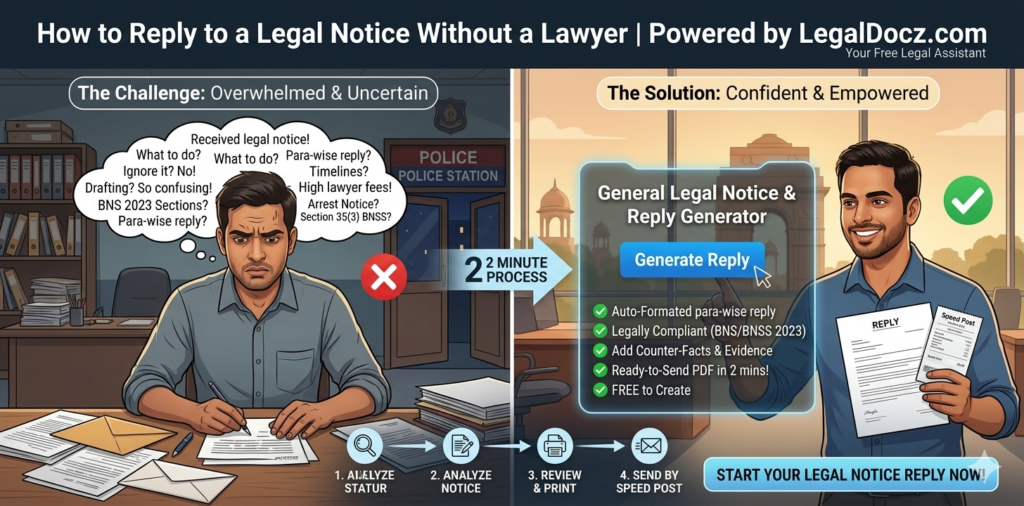
Drafting a response from scratch is intimidating. To help you maintain a professional tone and include the correct legal sections, use the LegalDocz General Legal Notice & Reply Generator.
Our tool allows you to:
-
Select the type of notice you received.
-
Input your counter-facts.
-
Automatically include BNS 2023 compliant terminology.
-
Generate a ready-to-send PDF.
Essential Checklist for Sending Your Reply
Once your reply is ready, follow these “Gold Standards” of service to ensure it is legally valid:
-
Mode of Dispatch: Always send your reply via Speed Post or Registered Post AD. Do not rely solely on WhatsApp or Email.
-
The “Deemed Service” Rule: Keep your postal receipt. If you send a notice to the correct address and the sender refuses it, the law “deems” it as delivered.
-
Attach Evidence: If you have receipts, screenshots, or emails that prove the sender is wrong, mention them as “Annexures” in your reply.
-
Maintain Professionalism: Avoid aggressive or emotional language. A calm, factual tone is more respected by judges.
Frequently Asked Questions (FAQs)
1. Is it mandatory to reply to a legal notice? Technically, no statute says you must reply. However, strategically, it is essential. Failure to reply can be treated as an “implied admission” of the facts in court.
2. Can I reply to a notice via WhatsApp? While courts recognize digital evidence, a physical reply via Speed Post is the only way to ensure an “irrefutable paper trail.” Always send a physical copy.
3. What if I missed the 15-day deadline? You should still send a reply as soon as possible. Add a “Preliminary Objection” stating that the delay was due to [Reason] and that you are acting in good faith.
4. Does a reply mean I am admitting guilt? No. A reply is simply your stand on the matter. You can explicitly deny all liability while explaining your version of the facts.
5. What is Section 35(3) of BNSS? This is a notice issued by the police for offenses where imprisonment is less than 7 years. Complying with this notice is mandatory and usually prevents an immediate arrest.
6. Can I send a “Counter-Notice”? Yes. If the original notice contains false allegations that damage your reputation, you can use your reply to demand an apology or damages for defamation.
7. Should I address the reply to the lawyer or the client? Send the reply to the Advocate who sent the notice, and mark a copy to the Client (the sender). This ensures everyone is legally informed.
8. What happens if the sender refuses to accept my reply? The post office will return the envelope with a “Refused” stamp. Do NOT open it. Keep it sealed; it is proof in court that you tried to resolve the matter but the sender was non-cooperative.
9. Can I change my stand later in court? It is very difficult. Statements made in a legal notice or reply are considered “admissions.” This is why using a tool like the LegalDocz Generator is safer than writing an emotional letter.
10. How much does it cost to send a reply via Speed Post? Usually between ₹40 to ₹100. This is a tiny price to pay to protect yourself from a case worth lakhs.